
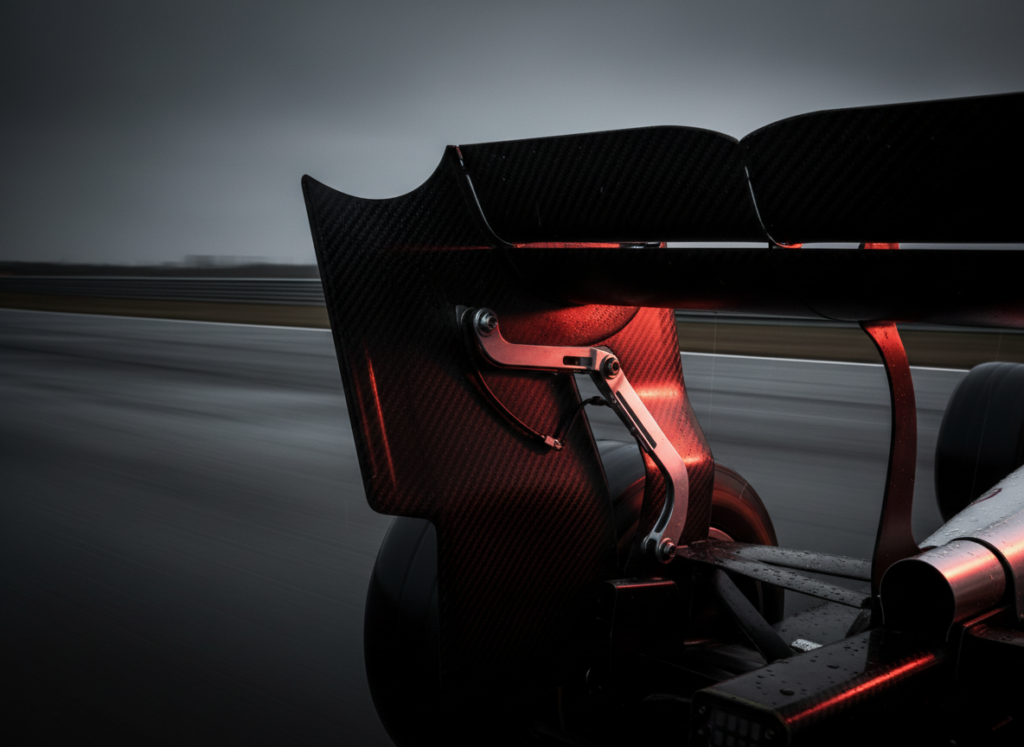
Understanding how DRS works in F1 is essential for any motorsport fan.
Speed is everything in Formula 1. But passing the car in front? That’s a different beast entirely.
At 200+ mph, aerodynamic drag turns overtaking into a near-impossible task. The car behind gets battered by dirty air, loses downforce, and watches the gap stay frustratingly the same. That was the reality of F1 racing for decades — until DRS changed the game forever.
Since 2011, DRS has been the most talked-about, most debated, and most misunderstood system in motorsport. Some call it artificial. Others call it essential. Either way, it’s reshaped how F1 races are won and lost.
Here’s exactly how it works — and why it matters more than you think.
What Is DRS? The Basics Explained
DRS stands for Drag Reduction System. It’s a movable flap built into the rear wing of every F1 car.
When activated, the flap opens by approximately 50mm, reducing aerodynamic drag by around 10-12%. The result? A straight-line speed boost of roughly 10-12 km/h (6-7 mph) — enough to make a real difference when attacking a rival into a braking zone.
The system was introduced by the FIA for the 2011 season with one clear goal: increase overtaking opportunities and make races more exciting.
Before DRS, following another car closely was almost suicidal for lap times. The dirty, turbulent air destroyed front wing performance and caused drivers to back off. DRS was the FIA’s answer to that problem.
How Does DRS Actually Work — The Technical Side
The mechanics are elegant in their simplicity.
Every F1 car features a two-element rear wing. The upper flap is connected to an actuator — a small hydraulic or electro-hydraulic device controlled directly by the driver via a button on the steering wheel.
When the driver hits the DRS button:
- The rear wing flap pivots open at the top
- The gap between the two elements increases from around 15mm to 65mm
- Air flows through the gap instead of being pushed against the wing
- Drag drops dramatically
- The car accelerates harder down the straight
When the driver brakes for the corner ahead, DRS automatically closes — either by the driver releasing the button or by the deceleration forces themselves snapping the flap shut. Safety first.
The entire system weighs under 1 kg. The performance gain it delivers is enormous relative to that weight.
When Can F1 Drivers Use DRS?
This is where most fans get confused — DRS isn’t a free-for-all button.
There are strict rules governing exactly when and where it can be used:
- DRS Zones: Designated detection and activation points on every circuit. Most tracks have 2-3 DRS zones, always on the longest straights.
- The 1-Second Rule: A driver can only activate DRS if they are within 1 second of the car ahead when passing the detection point. This gap is measured by timing loops embedded in the track surface.
- Race Laps Only: DRS is available from lap 3 of a race onwards. The first two laps are DRS-free to prevent pile-ups at the start.
- Safety Car Periods: DRS is disabled whenever the Safety Car or Virtual Safety Car is deployed.
- Wet Conditions: Race directors can disable DRS entirely in wet weather if the speed differential becomes dangerous.
In qualifying and practice, drivers can use DRS freely on any straight — the 1-second rule doesn’t apply outside of race conditions.
DRS Zones: How Circuits Are Designed Around the System
Circuit designers work closely with the FIA to place DRS detection and activation points strategically.
The detection point (where the 1-second gap is measured) is always placed just before the activation point (where drivers can open the flap). This gap — usually 50-100 meters — gives attacking drivers a brief moment to close in before the straight begins.
Some of the most famous DRS zones in the F1 calendar:
- Monza, Italy — Three DRS zones on the longest straights in F1. Pure carnage.
- Baku, Azerbaijan — The 2.2 km straight on the castle section is one of the longest in the sport. DRS here generates insane top speeds, regularly exceeding 360 km/h.
- Circuit de Barcelona-Catalunya — The main straight DRS zone is crucial for overtaking at a circuit notorious for being impossible to pass at.
- Spa-Francorchamps, Belgium — The Kemmel Straight DRS zone after Eau Rouge is one of the most thrilling in the sport.
Different circuits have different numbers of zones. Street circuits like Monaco and Singapore often have fewer or more restricted zones due to the nature of the layout.
DRS vs No DRS: The Numbers
Let’s talk hard data, because the performance difference is staggering.
At a typical F1 circuit:
| Metric | Without DRS | With DRS |
|---|---|---|
| Rear wing drag reduction | 0% | ~10-12% |
| Top speed gain | 0 km/h | +10-12 km/h |
| Braking distance (approx.) | Standard | Slightly longer |
| Overtaking probability | ~15-20% | ~45-60% |
The speed gain sounds small. But at 300+ km/h, an extra 10 km/h means arriving at the braking zone significantly faster — giving the attacking driver a decisive advantage into the corner.
At Monza in 2023, cars regularly hit 354-358 km/h in DRS zones. Without DRS, those same cars would be running around 10 km/h slower on the same straight.
Why DRS Is So Controversial
Not everyone loves DRS. In fact, plenty of F1 purists absolutely hate it.
The criticism is simple: DRS makes overtaking too easy.
When a faster driver closes in, hits the DRS button, and sails past on the straight with zero resistance from the defending driver — it feels hollow. There’s no wheel-to-wheel battle. No late braking move. No real drama. Just a highway pass.
Some of the loudest critics include:
- Former drivers who argue modern overtaking lacks the skill of the pre-DRS era
- Engineers who believe dirty air is a fundamental problem DRS papers over rather than solves
- Fans who want to see genuine racing, not artificial assistance
The FIA has acknowledged these concerns. The introduction of ground effect aerodynamics in 2022 was specifically designed to reduce dirty air sensitivity and make cars easier to follow — reducing the dependency on DRS over time.
There’s also a safety argument. A car running with DRS open is less stable. If a tire blows at 354 km/h with the rear wing open — as happened with Sebastian Vettel at Spa in 2013 — the consequences can be terrifying.
DRS in 2024 and Beyond — Is It Being Phased Out?
The conversation around DRS has shifted significantly since the 2022 regulation changes.
With the new generation of cars generating more downforce from ground effect (the underfloor) rather than wings, following closely became easier. The 1-second gap that once destroyed lap times is now far more manageable.
Several drivers and team principals have publicly called for DRS to be abolished — arguing that the new cars no longer need it. Max Verstappen, Lando Norris, and Lewis Hamilton have all expressed openness to racing without it.
The FIA has been monitoring the data closely. The likelihood is that DRS either gets restricted further (fewer zones, smaller flap angles) or eliminated entirely within the next regulation cycle — potentially by 2026.
Until then? It stays. And every tenth of a second within that 1-second window still matters.
Conclusion: DRS Is Imperfect — But It Changed F1 Forever
Love it or hate it, DRS reshaped Formula 1 racing.
Before 2011, races were often processional affairs where qualifying position determined race result. DRS cracked that formula open and gave drivers a genuine weapon to attack with.
Is it perfect? No. Does it sometimes produce passes that feel too easy? Absolutely. But it also gave us some of the most dramatic late-race battles in modern F1 history — drivers hunting each other down, gambling on when to use the system, defending with everything they had.
The debate around DRS reflects something deeper: the eternal tension in motorsport between technology and raw racing. That tension never gets old.
Want more deep dives into F1 tech and motorsport analysis? Browse The Pit Speed for weekly breakdowns, car reviews, and everything the world of speed has to offer.
FAQ
Q: Can F1 drivers use DRS whenever they want? No. In races, DRS can only be activated when a driver is within 1 second of the car ahead at a designated detection point, and only within marked DRS zones on the circuit. In qualifying and practice, it can be used freely on any straight.
Q: How much faster does DRS make an F1 car? DRS typically adds around 10-12 km/h of straight-line speed by reducing rear wing drag by approximately 10-12%. At circuits like Monza and Baku, this can push top speeds beyond 355 km/h.
Q: Will DRS be removed from F1? It’s a real possibility. Since the 2022 aerodynamic regulation overhaul, cars are easier to follow closely, reducing the need for artificial overtaking aids. Several drivers and the FIA itself have discussed phasing DRS out — potentially as soon as the 2026 regulation changes.