
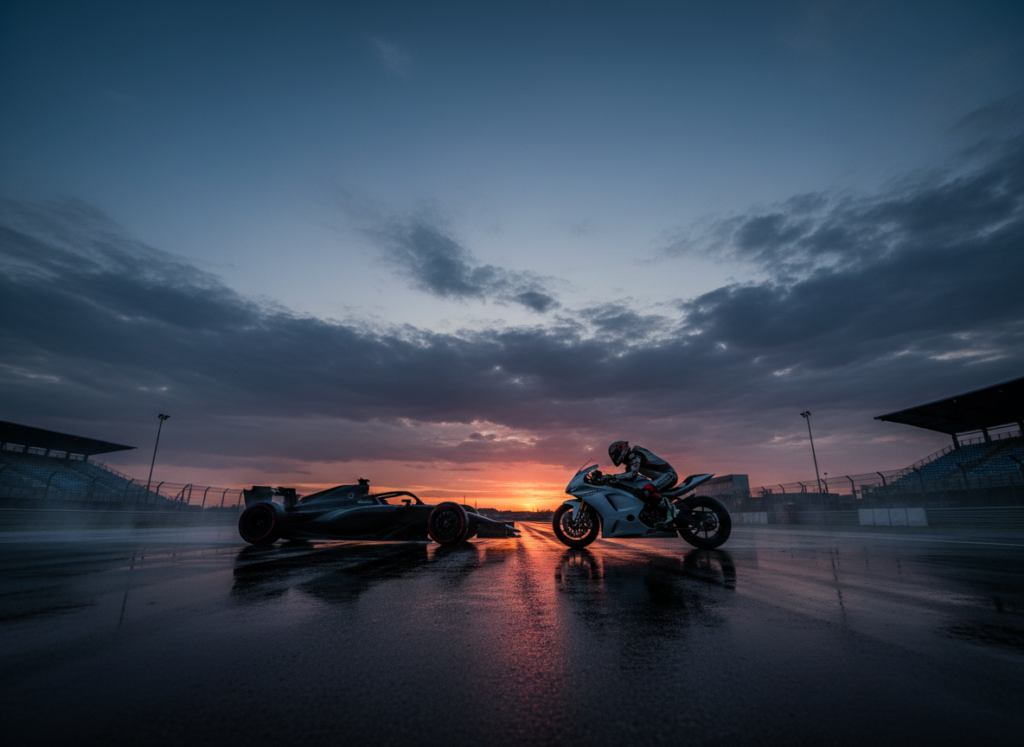
Formula 1 vs MotoGP: it’s the question every motorsport fan argues about — four wheels versus two, in the ultimate motorsport debate.
Both series sit at the absolute pinnacle of their respective disciplines. Both attract the most talented drivers on the planet. Both push engineering to its absolute limit.
But which one is actually faster? Which demands more from its athletes? And which produces better racing?
We ran the numbers, analyzed the data, and settled this argument once and for all.
The Speed Comparison: Lap Times Head to Head
The most obvious comparison — raw lap time — is also the most revealing.
Both series race at several of the same circuits, giving us direct comparisons. The numbers might surprise you.
At Circuit de Barcelona-Catalunya in Spain:
| Series | Best Lap Time | Top Speed |
|---|---|---|
| Formula 1 | 1:12.272 (Verstappen, 2023) | 354 km/h |
| MotoGP | 1:38.442 (Bagnaia, 2023) | 310 km/h |
F1 is dramatically faster around a full lap — by over 26 seconds at Barcelona. On pure lap time, there’s no contest.
But here’s where it gets interesting. Strip away the corners, and look purely at straight-line speed — the gap narrows significantly. MotoGP bikes regularly hit 340-360 km/h on fast circuits like Mugello, where the Ducati Desmosedici GP recorded a staggering 366.1 km/h in 2023.
Top F1 speed at Monza that same year? 372 km/h.
The margin is far smaller than most people expect.
Why F1 Is So Much Faster Through Corners
The lap time gap comes almost entirely from cornering speed — and the reason is aerodynamic downforce.
A modern F1 car generates between 3,000-5,000 kg of downforce at full speed. That means at 250 km/h, the car is being pushed into the ground with a force equal to three times its own weight.
The result? F1 cars corner at speeds that would be physically impossible for a motorcycle.
- F1 lateral g-force in corners: up to 6G
- MotoGP lateral g-force in corners: up to 1.5G
MotoGP bikes lean instead of generating downforce — reaching lean angles of 68 degrees from vertical. It’s a completely different physics problem.
Neither approach is superior — they’re just different solutions to the same challenge of going fast around a circuit.
Which Is Harder to Drive?
This is the question that starts arguments at every motorsport paddock in the world.
F1 drivers will tell you nothing compares to managing 1,000+ hp through a corner at 6G while operating a steering wheel with 25 different functions. The physical and mental load is extraordinary.
MotoGP riders will tell you that sitting on a 300 hp motorcycle with nothing between you and the tarmac — leaning at 68 degrees at 200 mph — requires a different kind of courage entirely.
Both arguments are valid. Here’s the honest breakdown:
Formula 1 demands:
- Exceptional mental processing speed — over 1,500 data inputs per lap
- Extreme neck strength — sustaining 6G lateral forces for 90 minutes
- Precision car control at the limit of physics
- Strategic thinking — managing tyres, fuel, DRS, team radio simultaneously
MotoGP demands:
- Raw physical bravery at a level F1 rarely requires
- Exceptional balance and body positioning — leaning further than most humans can stand
- Split-second reactions with zero mechanical protection
- The ability to manage a bike that actively tries to crash in corner entry
The consensus among drivers who have done both — like former F1 racer and MotoGP champion John Surtees, the only man to win world championships on both two and four wheels — is that they are incomparably different challenges.
Surtees himself called MotoGP “more physically dangerous” and F1 “more technically demanding.” That probably settles it.
The Machines: F1 Car vs MotoGP Bike
The engineering behind both machines is genuinely extraordinary.
| Spec | Formula 1 Car | MotoGP Bike |
|---|---|---|
| Engine | 1.6L V6 Hybrid | ~1.0L Inline-4 |
| Power output | ~1,000 hp | ~290 hp |
| Weight | 798 kg (with driver) | ~157 kg (without rider) |
| Power-to-weight | ~1,254 hp/ton | ~1,847 hp/ton |
| Top speed | 372 km/h | 366 km/h |
| 0-200 km/h | ~4.5 seconds | ~4.5 seconds |
Here’s the stat that blows people’s minds: MotoGP bikes have a higher power-to-weight ratio than F1 cars. The Ducati GP23 produces around 1,847 hp per ton versus F1’s approximately 1,254 hp per ton.
That’s why straight-line acceleration from low speeds is actually comparable between the two — and why MotoGP bikes can embarrass supercars off the line.
The F1 car’s advantage is entirely in its ability to carry that speed through corners.
Which Produces Better Racing?
This is subjective — but the data tells an interesting story.
Formula 1 has historically been criticized for processional racing where qualifying position determines race result. DRS and the 2022 regulation changes have improved this significantly, but F1 still produces fewer position changes per race than MotoGP.
MotoGP, by contrast, consistently delivers some of the most chaotic, unpredictable racing in motorsport:
- Multiple different winners in a single season is the norm, not the exception
- Crashes are frequent and dramatic — adding genuine jeopardy
- Last-lap battles happen at virtually every round
- The gap between the best and worst teams is smaller than in F1
In 2023, MotoGP had 10 different race winners from 20 rounds. F1 had 6 different winners but Max Verstappen took 19 of 22 victories — the most dominant season in the sport’s history.
If you want championship suspense and unpredictable outcomes, MotoGP wins this argument comfortably.
The Verdict: Formula 1 vs MotoGP
There is no wrong answer here — both series are exceptional. But here’s the honest summary:
Formula 1 is faster — by a significant margin on lap time, due to aerodynamic downforce generating cornering speeds that motorcycles can never match.
MotoGP is more dangerous — the physical exposure of a rider versus the carbon fiber survival cell of an F1 cockpit makes this undeniable.
MotoGP produces better racing — more winners, more unpredictability, more last-lap drama on a consistent basis.
F1 has more prestige and global reach — the budgets, the technology, the glamour, and the global TV audience are all larger.
The real answer? Watch both. Follow both. Appreciate both for what they are — the two greatest forms of motorsport racing on the planet.
Conclusion: Stop Choosing Sides
The Formula 1 vs MotoGP debate misses the point.
Both series exist at the absolute frontier of human performance and engineering. Both produce athletes who are among the most talented sportspeople on Earth. Both will have you on the edge of your seat if you give them a chance.
The motorsport fan who watches both is the smartest fan in the room.
Stay at The Pit Speed for weekly F1 analysis, MotoGP breakdowns, car reviews and everything the world of speed has to offer.
FAQ
Q: Is Formula 1 faster than MotoGP? Yes — F1 cars are significantly faster around a complete lap due to their enormous aerodynamic downforce, which allows them to corner at speeds impossible for motorcycles. At Barcelona, the best F1 lap is over 26 seconds faster than the best MotoGP lap. However, top straight-line speeds are comparable, with both series exceeding 360 km/h at fast circuits.
Q: Is MotoGP more dangerous than Formula 1? Statistically yes. MotoGP riders have no protective cell around them — a crash at 300 km/h means direct contact with the tarmac. F1 drivers are enclosed in a carbon fiber survival cell with the Halo protection system. Both sports have become dramatically safer in recent decades, but MotoGP carries inherently greater physical risk.
Q: Have any drivers competed in both Formula 1 and MotoGP? Very few have competed seriously in both at the top level. John Surtees remains the only person in history to win World Championships on both two wheels (MotoGP) and four wheels (Formula 1). Several drivers have tested or raced in both series at lower levels, but the skill sets are different enough that crossing over at the elite level is extraordinarily rare.