
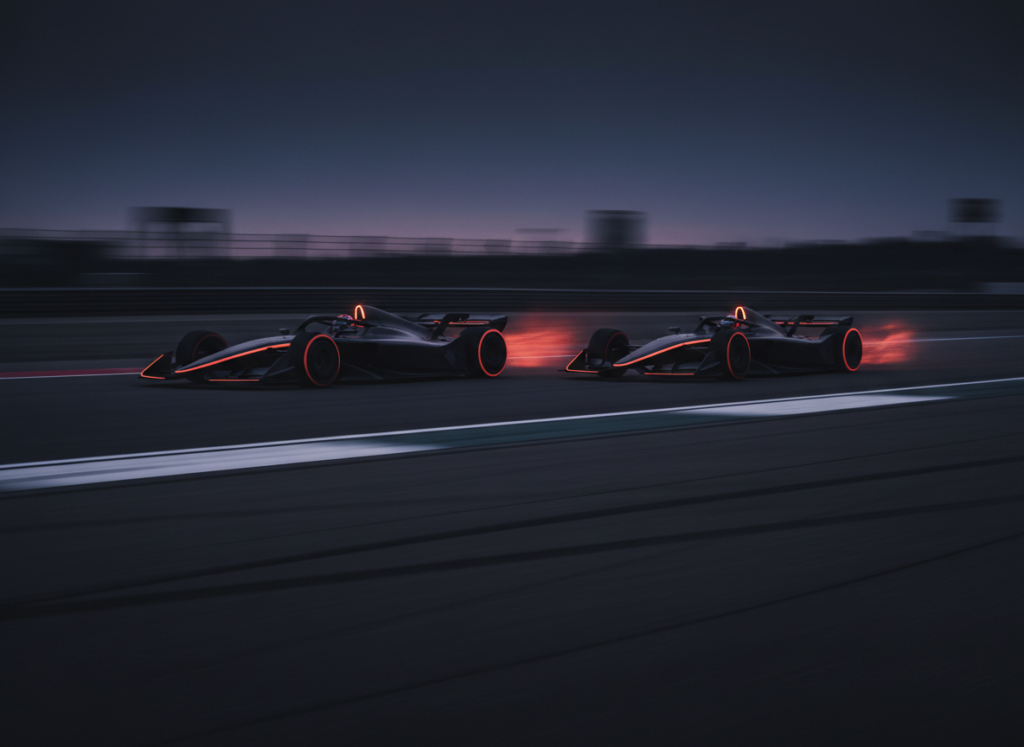
For motorsport fans in the US and Europe, the debate of F1 vs IndyCar is a constant talking point. Both represent the pinnacle of open-wheel racing in their respective regions, but they are fundamentally different in their engineering philosophies, chassis designs, and business models. If you want to understand which series boasts the fastest cars, the most advanced technology, and the most demanding tracks, you have to look at the data beneath the bodywork. Analyzing these structural frameworks reveals the underlying business strategies defining modern global motorsports. These key metrics highlight the unique economic drivers of both.
The Engineering Philosophy: Constructors vs. Spec Series
The most significant difference between Formula 1 and IndyCar lies in how the cars are built.
Formula 1 is a constructor’s championship. Every team is required to design, manufacture, and develop their own chassis and aerodynamic components from scratch. This makes F1 an engineering arms race. Conversely, IndyCar operates as a “spec” series. All teams purchase the exact same base chassis manufactured by Dallara. While IndyCar teams can adjust suspension geometries and setups, they cannot completely redesign the car’s aerodynamic profile. This levels the playing field significantly, placing a heavier emphasis on driver adaptation rather than pure engineering dominance.
Aerodynamics and Mathematical Optimization
When comparing cornering speeds in the F1 vs IndyCar debate, Formula 1 is the undisputed king.
F1 cars are marvels of mathematical optimization. Teams run endless computational fluid dynamics (CFD) simulations to solve complex equations, seeking to maximize downforce while strictly minimizing aerodynamic drag. The result is a vehicle capable of generating up to 5G of lateral force in high-speed corners. IndyCar, while producing less overall downforce, utilizes two completely different aerodynamic packages: one for traditional road/street courses and a highly trimmed, low-drag package specifically designed for superspeedway ovals like the Indianapolis 500.
Engine Architecture and Top Speed Capabilities
Under the engine cover, both series utilize 2.2 to 1.6-liter V6 engines, but the hybridization sets them apart.
F1 utilizes a 1.6-liter V6 turbocharged hybrid power unit (incorporating the MGU-K and MGU-H), producing over 1,000 horsepower with astonishing acceleration metrics. IndyCar runs a 2.2-liter twin-turbocharged V6 that produces roughly 700 to 750 horsepower. However, when it comes to raw top speed, IndyCar takes the crown. Because IndyCars race on massive ovals with their low-drag aero kits, they regularly exceed 235 mph (380 km/h) on the straights. F1 cars, optimized for downforce and rapid direction changes on circuit tracks, typically max out around 220 mph (354 km/h) depending on the track layout (you can compare technical regulations on the official FIA website).
Analyzing the Cost Systems and Financial Models
Analyzing the cost systems of both series reveals why their global footprints are so distinct.
Because IndyCar uses standardized Dallara parts, a competitive team can operate on a budget of roughly $15 to $20 million per season. The financial barrier to entry is relatively low, allowing for a highly diverse grid of independent owners. In contrast, the development costs in Formula 1 are astronomical. Even with modern financial regulations and budget caps, an F1 operation requires hundreds of millions of dollars annually to fund relentless R&D cycles, wind tunnel testing, and global logistics. Understanding how teams generate F1 team revenue is essential to comprehending how they sustain such aggressive development programs.
Ultimately, choosing between F1 and IndyCar isn’t about finding which is objectively “better,” but rather appreciating two very different applications of motorsport engineering, data analytics, and macroeconomics. While Formula 1 pushes the absolute boundaries of aerospace engineering and big data processing, IndyCar delivers a raw, fiercely competitive spec-series where the driver’s mechanical intuition reigns supreme.