
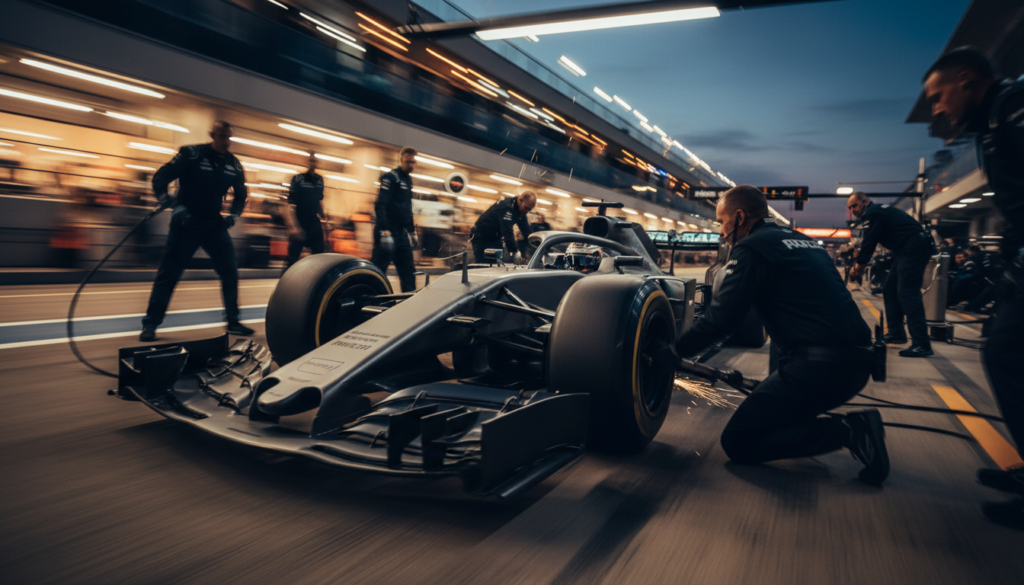
Twenty-four seconds. That is roughly how long a modern Formula 1 pit stop costs a driver once the in-lap, the stationary wheel change and the out-lap back up to speed are all added together. The wheel change itself takes barely two seconds under the garage lights. The real contest for position happens somewhere else entirely: in the lap-by-lap arithmetic that decides exactly when a driver comes in at all.
Engineers call this pit stop timing, and it has become one of the most mathematically precise, and most second-guessed, parts of any race weekend. Get the window right and a driver can jump two or three cars without passing a single one of them on track. Get it wrong by even a lap, and a podium can evaporate over one radio call.
What “Pit Stop Timing” Actually Means
Every tyre compound has a window in which it performs at its best before degradation erodes grip faster than a driver can manage around it. A strategist is not simply picking a lap number; they are comparing two different futures for the same car — staying out on ageing rubber, or pitting onto fresh tyres and rejoining further back in traffic — and working out which one produces the better finishing position several laps later. That comparison is where two classic strategic plays come from: the undercut and the overcut.
The Undercut: Pitting Early to Steal the Position
The undercut is the more common of the two plays. A driver stops a lap or two before a rival ahead, switches onto fresh rubber, and uses the grip advantage of new tyres to set lap times quick enough to erase the time lost in the pit lane before that rival even reaches the pit entry. By the time the rival does stop, they rejoin behind, despite never being passed in a conventional overtaking move. The whole tactic hinges on how much faster new tyres are than tyres that already have ten or fifteen laps of wear on them, a gap that shifts with compound, track surface and ambient temperature.
The Overcut: When Staying Out Wins
The overcut flips that logic around. If a rival pits straight into traffic, or if the tyres already on the car are degrading more slowly than the model predicted, staying out longer lets a driver bank extra laps in clear air before making a later stop on tyres that still have performance left. It is the riskier of the two plays, because it depends entirely on the degradation model holding up: a tyre that falls off a lap earlier than expected can turn a clever overcut into a lost position almost instantly.
The Numbers Behind the Call
Pit Lane Loss Time Differs by Circuit
Pit lane loss, the total time surrendered by diving in rather than staying on track, is not a fixed number. It depends on how long the pit lane is, the speed limit enforced through it, and how far the pit entry sits from the racing line. On a circuit with a short, direct pit lane the loss can run close to 18 seconds; on a track with a long, winding pit road it can stretch well past that. Strategists build this figure into every undercut and overcut calculation long before the race even starts, which is one reason the sport’s technical rulebook matters as much as it does — our breakdown of how the 2026 regulations are reshaping race strategy covers how those changes ripple into exactly this kind of decision.
Tyre Degradation Curves
Teams model how each compound will fall off lap by lap using a mix of practice data, historical track information and simulation software, then refine that model in real time as the race unfolds. The compounds themselves, their construction, their rate of thermal degradation, how they grain or blister, are a specialised engineering problem in their own right, and we go deeper on that in our guide to how racing tyres are actually made. A strategist who underestimates how quickly a tyre will fall away is really underestimating how much time an undercut attempt will actually gain.
Traffic and Track Position Risk
Pitting always carries the risk of rejoining behind a car running a different strategy entirely — one on older tyres but light on fuel, or one that pitted a lap earlier and is already back up to speed. A perfectly timed undercut can still be undone by a slower car blocking the out-lap for even half a second, which is why race engineers are constantly recalculating the gaps to the cars both ahead and behind, not just to the one rival they are actually racing against.
Safety Cars and Virtual Safety Cars: The Wildcard
Nothing rewrites a pit stop calculation faster than a Safety Car. Because the whole field bunches up behind it, pitting during that period erases most of the time penalty a stop would normally cost, turning a scheduled stop into what teams call a “free” one. That is why strategists hold a contingency plan for every car on track at all times: if a Safety Car appears, the pit call can flip in seconds, and the team that reacts first usually gains the most from it.
Why Strategy Calls Still Go Wrong
Even the best model can be undone by variables no simulation fully captures: a sudden shift in track temperature, a rival team mirroring the same move at the same moment, or a driver managing tyres that behave differently from the predicted curve. The maths of an undercut only works if the lap time gained on fresh rubber is larger than the time lost in the pit lane before the rival can respond, and that margin can be razor-thin, sometimes under a second across an entire pit sequence.
None of this happens in isolation from the rest of the weekend, either. A driver who starts further up the grid simply has more strategic options available, because they are not stuck managing dirty air from the car ahead — one more reason starting position carries so much weight, something we cover in our guide to how F1 qualifying actually works. Pit stop timing might look like a simple in-out manoeuvre on a TV graphic, but it is really a continuous, live negotiation between tyre physics, track position and a handful of seconds in the pit lane, recalculated every single lap of the race.