
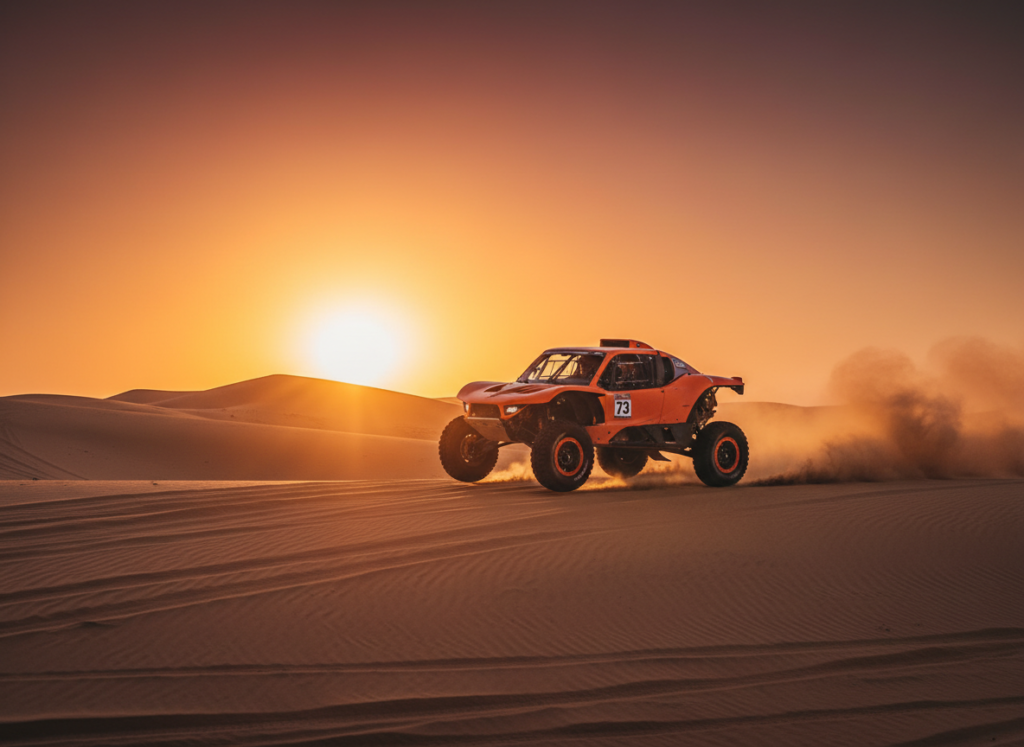
Every January, a convoy of cars, motorcycles, trucks and lightweight buggies disappears into some of the most unforgiving terrain on the planet, and by the finish line roughly two weeks later only a fraction of the entry list is still running. That is the basic premise of the event fans simply call Dakar. Unlike a Grand Prix weekend or a single circuit, this is motorsport stretched across an entire country, run largely without reconnaissance, and built as much around navigation as horsepower.
What Makes Dakar Different From Everything Else in Motorsport
Most motorsport disciplines fall into one of two buckets: closed-circuit racing, where cars lap a fixed track dozens of times, or stage rally, where crews drive memorised routes against the clock on public or forest roads. Dakar belongs to neither. It is rally-raid: a format where competitors cover vast, largely open terrain — dunes, riverbeds, rock fields, gravel plains — on routes they have never driven and, in most categories, cannot pre-scout. A single competitive stage can run anywhere from roughly 300 to 800 kilometres, several times longer than a typical World Rally Championship special stage, and the terrain changes constantly within that distance, from soft sand that swallows tyres to rocky outcrops that shred them.
From Paris to Dakar to the Arabian Desert
The race traces back to 1978, when French motorcyclist Thierry Sabine got lost crossing the Ténéré desert and decided the experience made for a compelling race rather than just a cautionary tale. The original Paris-Dakar Rally ran from Europe to Senegal through the Sahara, becoming one of the most mythologised events in motorsport through the 1980s and 1990s. Security concerns in Mauritania forced the cancellation of the 2008 edition just before the start, and organisers relocated the race to South America the following year, running across Argentina, Chile, Peru and Bolivia at various points between 2009 and 2019. Since 2020, Dakar has been held entirely within Saudi Arabia, where organisers have built one of the largest dedicated rally-raid route networks in the world — and where, for now, it remains.
The Vehicle Categories That Compete
Cars: Ultimate and Challenger
The headline class, Ultimate, is where manufacturer-backed teams run heavily modified prototypes built specifically for rally-raid — tube-frame chassis, long-travel suspension and, in recent years, hybrid powertrains from manufacturers including Toyota and Ford. Challenger-class regulations sit a tier below, built around more production-derived cross-country vehicles and lightweight prototypes, giving well-funded privateers and smaller teams a realistic shot at a class win without Ultimate-level budgets.
Motorcycles and Quads
Motorcycles are widely considered the purest — and most physically brutal — category, because riders navigate alone, reading the roadbook off a scrolling unit mounted on the handlebars while riding, with no co-driver to share the workload. Quads run a smaller, separate class under similar rules. Crashes, dehydration and simple navigational errors carry higher consequences here than in any other category, which is part of why bike riders are often held up as the discipline’s toughest competitors.
SSVs and Trucks
Side-by-sides (SSVs), lightweight tube-frame buggies derived from recreational off-road vehicles, have grown into one of Dakar’s fastest-expanding categories. The Trucks class, meanwhile, pits modified rally trucks against each other — a discipline long dominated by Russian manufacturer Kamaz — and doubles as a logistical backbone, since several truck entries also serve as service and recovery vehicles for the wider convoy.
Roadbook Navigation: Why There Are No Pace Notes
This is where Dakar diverges most sharply from the World Rally Championship, where co-drivers call pace notes written during closed reconnaissance runs days earlier. Dakar competitors receive their roadbook — a scrolling paper or digital strip of distances, compass headings, GPS waypoints and hazard symbols — only shortly before each stage starts, and reconnaissance is banned outright. Crews navigate live, deciding in real time whether a dry riverbed on the roadbook matches the one in front of them. A missed waypoint or a wrong turn into a dune field can cost a competitor hours rather than seconds, which is why navigation skill separates genuine contenders from fast drivers who simply get lost.
Stages, Marathon Days and the Bivouac
A typical Dakar day combines a timed special stage with liaison sections — untimed transit road sections that still carry time penalties if a competitor arrives late. One or more rest days break up the roughly two-week event, and several editions have included marathon stages, where crews are sealed off from their full service crews overnight and must handle basic repairs themselves. The entire operation is supported by the bivouac, a temporary tent city of workshops, medical facilities and living quarters that relocates along the route night after night, effectively becoming a mobile town for the length of the rally.
Why Dakar Is Considered Motorsport’s Ultimate Endurance Test
Where the 24 Hours of Le Mans compresses endurance into a single circuit across one day and night, Dakar spreads a comparable physical toll over roughly two weeks of changing terrain, heat and sleep deprivation, with real consequences for a wrong turn or a mechanical failure far from help. Medical helicopters, satellite tracking beacons and strict time cut-offs are built into the event because the risk involved is genuine, not theatrical. It is this combination of raw distance, unpredictable terrain and limited support that keeps Dakar appearing on lists of the best motorsport series in the world, even among readers who otherwise follow only circuit racing.
Frequently Asked Questions
Is the Dakar Rally part of the World Rally Championship?
No. They are entirely separate disciplines run by different sporting bodies, though both involve driving at speed on loose, unpaved surfaces. The WRC is closed-stage rally with pre-written pace notes; Dakar is open-terrain rally-raid navigated live via roadbook.
How long does the Dakar Rally last?
Dakar typically runs for around two weeks, made up of roughly a dozen stages plus one or more rest days, though the exact stage count and route change from year to year.
Can amateurs enter the Dakar Rally?
Yes, within limits. Alongside factory-backed Ultimate teams, Dakar includes classes aimed at privateers and amateur entrants, particularly in the motorcycle and Challenger car categories, though the cost, logistics and physical demands of entering mean most amateur crews still need significant backing just to reach the start line.