
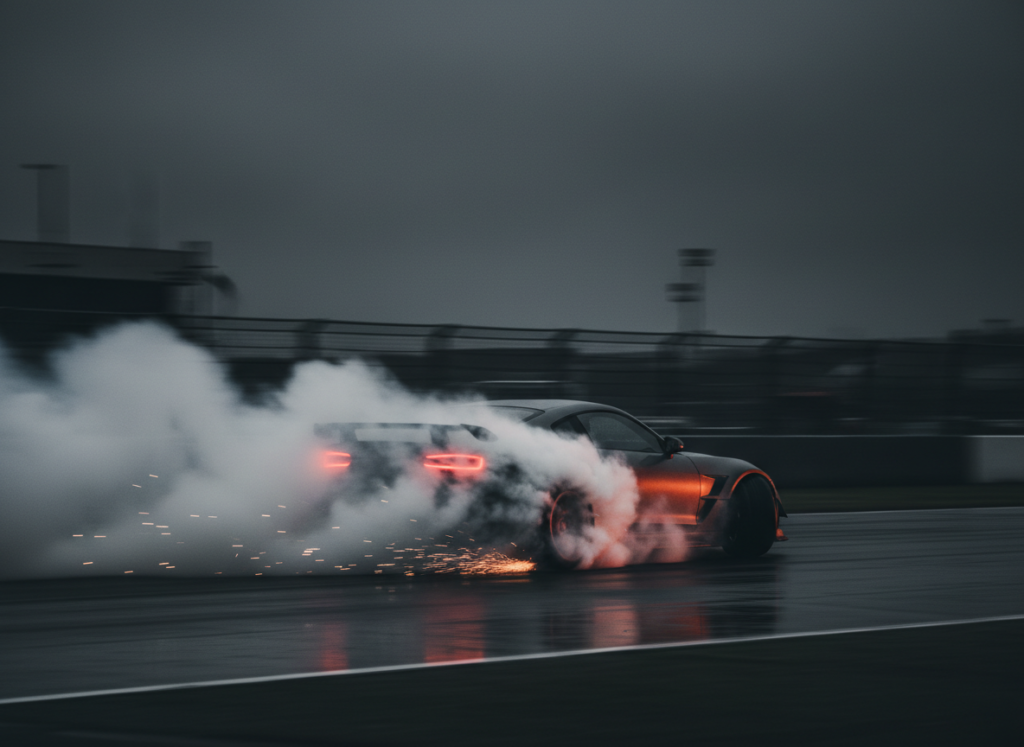
Oversteer vs understeer explained — two terms you’ll hear in every motorsport broadcast, every car review, and every track day debrief. But what do they actually mean?
If you’ve ever watched an F1 car slide sideways out of a corner, or seen a front-wheel-drive hatchback plow straight on when the driver turns in — you’ve witnessed oversteer and understeer in action.
Understanding the difference between the two transforms how you watch motorsport, how you drive on a track, and how you assess any performance car. Here’s everything you need to know.
What Is Understeer?
Understeer happens when the front tires lose grip before the rear tires.
When a car understeers, the front end refuses to follow the steering input — instead of turning into the corner, the car continues in a straight line (or a wider arc than intended) regardless of how much steering lock the driver applies.
Picture a front-wheel-drive hatchback approaching a corner too fast. The driver turns the wheel. The front tires, already working at their grip limit to both steer and drive the car, give up. The car pushes wide — toward the outside of the corner — with the driver desperately turning the wheel further, which actually makes things worse.
Common causes of understeer:
- Entering a corner too fast
- Too much front weight bias
- Applying throttle too early in a front-wheel-drive car
- Understeer-biased suspension setup (common in road cars for safety)
- Cold or worn front tires
How to correct understeer:
- Reduce speed before the corner, not during it
- Release the throttle smoothly to transfer weight forward
- Reduce steering lock — counter-intuitively, less steering angle often helps
- Wait for the tires to regain grip before applying throttle
Most road cars are deliberately set up with mild understeer. It’s more predictable and easier for average drivers to manage than oversteer — even if it feels frustrating at the limit.
What Is Oversteer?
Oversteer is the opposite — the rear tires lose grip before the front tires.
When a car oversteers, the rear end steps out, rotating the car beyond what the driver intended. Instead of following the corner, the back of the car swings wide — pointing the nose toward the inside of the corner.
Left uncorrected, oversteer leads to a spin. Corrected with skill and timing, it becomes a controlled slide — the most visually spectacular thing in motorsport.
Common causes of oversteer:
- Too much throttle on corner exit in a rear-wheel-drive car
- Trail braking — maintaining brake pressure while turning in
- Rear weight bias in the setup
- Cold or worn rear tires
- Sudden lift-off of the throttle mid-corner (lift-off oversteer)
How to correct oversteer:
- Counter-steer — turn the wheel in the opposite direction to the slide
- Manage throttle — too much accelerates the spin, too little kills momentum
- Smooth inputs — sudden corrections make oversteer worse, not better
- Look where you want to go, not at the wall
Oversteer correction is a skill that takes time to develop. The instinct when the rear slides is to brake and turn away from the slide — both of which make it dramatically worse.
Oversteer vs Understeer: The Key Differences
| Understeer | Oversteer | |
|---|---|---|
| Which tires lose grip | Front | Rear |
| What the car does | Pushes wide, won’t turn | Rear swings out, rotates |
| Common in | Front-wheel-drive cars | Rear-wheel-drive cars |
| Driver correction | Reduce speed, less steering | Counter-steer, manage throttle |
| Danger level | More predictable | More dramatic, requires skill |
| Road car setup | Deliberately mild understeer | Rare in standard road cars |
How F1 Drivers Use Both to Go Faster
Here’s what separates elite drivers from good ones — they don’t just correct understeer and oversteer. They use them deliberately.
Rotating the car with oversteer
In slow and medium-speed corners, F1 drivers use trail braking — maintaining light brake pressure while turning in — to deliberately induce mild oversteer. This rotates the rear of the car into the corner, tightening the line and allowing earlier throttle application.
It’s a technique that looks like the car is on the edge of losing control. It isn’t — it’s a precisely calculated use of rear grip to optimize the car’s trajectory.
Managing understeer with setup
Every F1 car has a balance between understeer and oversteer that the driver and engineer dial in for each circuit. Some drivers — like the late Michael Schumacher — preferred slight understeer because it made the car more stable under braking. Others, like Max Verstappen, prefer a more neutral or slightly oversteering balance that allows more aggressive rotation.
The setup decisions made in Friday practice sessions — spring rates, anti-roll bar stiffness, differential settings, aerodynamic balance — all affect where the car sits on the understeer-oversteer spectrum.
Real World Examples From Motorsport
Classic understeer: Watch any clip of a touring car race at a slow hairpin. You’ll see drivers fighting the front end, turning the wheel aggressively as the car refuses to rotate. That’s understeer in its most visible form.
Spectacular oversteer: Highlight reels of Ken Block’s Gymkhana videos, any Ken Miles Can-Am clip, or modern Formula Drift events show sustained, controlled oversteer — the driver constantly counter-steering to maintain the slide angle.
F1 oversteer correction: Watch onboard footage from any wet F1 race. You’ll see drivers making tiny, rapid counter-steer corrections constantly as the rear moves around. Carlos Sainz and Fernando Alonso are particularly good examples of drivers who manage rear instability with exceptional smoothness.
Which Is More Dangerous?
Both oversteer and understeer can result in accidents — but they fail differently.
Understeer tends to fail slowly and predictably. The car runs wide, the driver has time to react, and the usual outcome is running off track at a moderate speed. It’s the safer failure mode, which is why road cars are engineered to understeer.
Oversteer can fail fast and violently. If the driver overcorrects — or doesn’t correct at all — the car spins. At speed, a spin can send the car backwards into a barrier, which is among the most dangerous crash configurations in motorsport.
However, a skilled driver can catch oversteer that an unskilled driver cannot. That asymmetry is what makes rear-wheel-drive, oversteer-prone cars so rewarding — and so unforgiving.
Conclusion: Two Sides of the Same Physics Problem
Oversteer vs understeer — understanding both is fundamental to understanding how cars work at their limits.
Every car, on every corner, exists somewhere on the spectrum between the two. The best drivers find the car’s balance point and exploit it. The best engineers set the car up to put that balance point exactly where their driver wants it.
Whether you’re watching an F1 race on Sunday afternoon or attacking your favorite back road, knowing the difference between understeer and oversteer makes every corner more interesting.
Follow The Pit Speed for more technical breakdowns, car reviews, and everything the world of motorsport has to offer.
FAQ
Q: Is oversteer or understeer faster on a race track? A neutral balance — neither significant understeer nor oversteer — is theoretically fastest. However, most racing drivers prefer a slight oversteer bias because it allows the car to rotate more quickly through corners, enabling earlier throttle application on exit. The optimal balance depends on the circuit layout, tire characteristics, and individual driver preference.
Q: Why do road cars understeer by design? Road cars are deliberately engineered with mild understeer because it’s a more predictable and manageable failure mode for average drivers. When an inexperienced driver pushes beyond the limit, understeer — running wide — is far safer than oversteer — spinning — particularly at road speeds where the driver may have limited ability to correct a slide.
Q: What is lift-off oversteer? Lift-off oversteer occurs when a driver suddenly releases the throttle mid-corner. The sudden deceleration shifts weight forward onto the front tires, simultaneously reducing rear tire load and grip. The rear of the car steps out — sometimes dramatically. It’s particularly pronounced in rear-engined cars like the Porsche 911 and was a well-documented characteristic of older 911 models that caught many drivers off guard.