
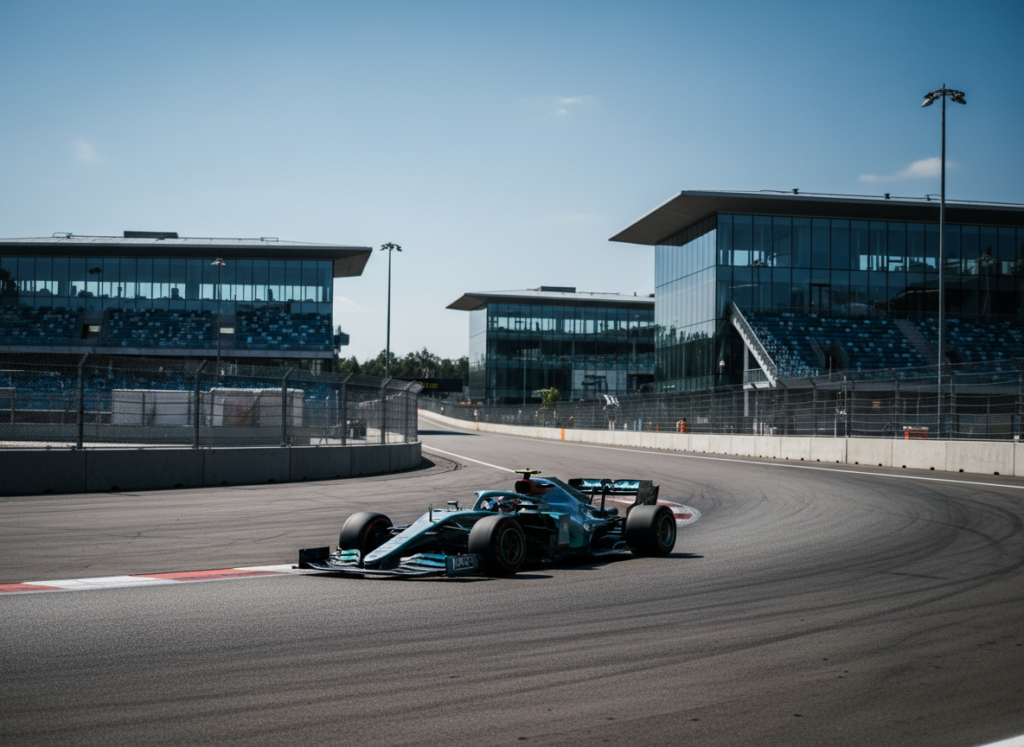
Formula 1 raced somewhere it had never raced before this weekend, and the result still ended up looking familiar. Kimi Antonelli won the inaugural Spanish Grand Prix at Madrid’s brand-new Madring circuit, holding off Max Verstappen and Lando Norris in a race that turned on tyre strategy, a mid-race Virtual Safety Car, and a first lap that nearly cost him the win before it had properly started.
A New Circuit Makes Its Debut
The Formula 1 Tag Heuer Gran Premio de España was run over 57 laps at the Madring, the purpose-built circuit at IFEMA Madrid hosting its first Grand Prix after Spain’s race moved away from Barcelona. Lando Norris took pole position, with Antonelli alongside him on the front row and Verstappen third — meaning none of the podium finishers actually started from the place they finished, on a layout where nobody on the grid had raced a Formula 1 car in anger before Friday practice.
A Messy Opening Lap Sets the Tone
Antonelli went after Norris almost immediately and cut the chicane twice during his opening-lap attempts to get past — the kind of aggressive, boundary-testing move that’s become more common as drivers probe the limits of a track nobody has real reference points for. A few corners further round, Carlos Sainz picked up a five-second penalty for a collision with Fernando Alonso at Turn 5, one of several incidents that made the first few laps considerably scrappier than a typical Sunday at an established circuit. Grid position and starting pace only tell part of the story at a new venue — for the mechanics of how that starting order gets set in the first place, see our guide to how F1 qualifying works.
The Virtual Safety Car That Decided the Race
The race pivoted on lap 14, when a brake failure for Lance Stroll at Turn 20 triggered a Virtual Safety Car. Antonelli, who had started the race on mediums, used the moment to pit for hard tyres and rejoined in control of the race. Russell’s Mercedes took the opposite route — starting on hards, switching to mediums under the VSC, then coming back onto hards later — but the alternate strategy didn’t pay off; he finished fifth regardless, telling his team afterward that “no matter what we had done with strategy today we would have finished P5.” Reading a Virtual Safety Car window correctly, and deciding whether it’s worth the risk of an early stop, is exactly the kind of calculation we cover in our breakdown of F1 race strategy and the mathematics behind pit calls.
Even Antonelli was candid about how much the timing worked in his favour, saying afterward that “we were a little bit fortunate with the timing of the Virtual Safety Car” and admitting the team “probably didn’t deserve to win.” He also described the race itself as “a very difficult race, not straightforward at all, especially trying to manage tyres” — an acknowledgment that the result flattered a genuinely hard-fought afternoon more than it looked from the outside.
Four Retirements on a Tough Debut Weekend
The Madring’s first Grand Prix claimed four cars before the finish. Lewis Hamilton retired with a brake issue on lap 7, Stroll’s brake failure ended his race at Turn 20, Sergio Pérez was out with a water system problem, and Sainz also failed to make it to the flag. A first-time venue testing new surfaces, kerbs and braking zones at full race distance and race temperatures tends to expose weaknesses that practice sessions don’t — a pattern that will be worth watching if the Madring returns to the calendar in 2027.
Spanish Grand Prix Result: Top Ten at the Madring
| Pos | Driver | Team | Gap / Time |
|---|---|---|---|
| 1 | Kimi Antonelli | Mercedes | 1:34:23.754 |
| 2 | Max Verstappen | Red Bull | +4.351s |
| 3 | Lando Norris | McLaren | +5.089s |
| 4 | Charles Leclerc | Ferrari | +29.116s |
| 5 | George Russell | Mercedes | +29.829s |
| 6 | Liam Lawson | Red Bull | — |
| 7 | Franco Colapinto | Alpine | — |
| 8 | Oscar Piastri | McLaren | — |
| 9 | Arvid Lindblad | Racing Bulls | — |
| 10 | Nico Hulkenberg | Audi | — |
Championship Fallout: A Record and a Growing Gap
The result stretched Antonelli’s lead in the drivers’ championship to 81 points over Russell, his own teammate, turning what was already a comfortable advantage into something close to a formality with several rounds still to run. It’s a jump built on the kind of new-regulation unpredictability we outlined in our look at how the F1 2026 regulations changed race strategy — new cars, new tracks and new tyre behaviour have consistently rewarded the driver and team best able to adapt on the fly, and this weekend was no exception.
There was a milestone buried in the result, too: the win was Mercedes’ 251st as an engine manufacturer, equalling Ferrari’s all-time record for engine victories in Formula 1. For a power unit story that started this season with plenty of scepticism about whether Mercedes could keep pace with Red Bull and Ferrari’s latest units, matching the sport’s most decorated manufacturer at the first attempt on a completely new track is a statement in itself — even if, by Antonelli’s own admission, the day owed as much to a well-timed Virtual Safety Car as it did to outright pace.