
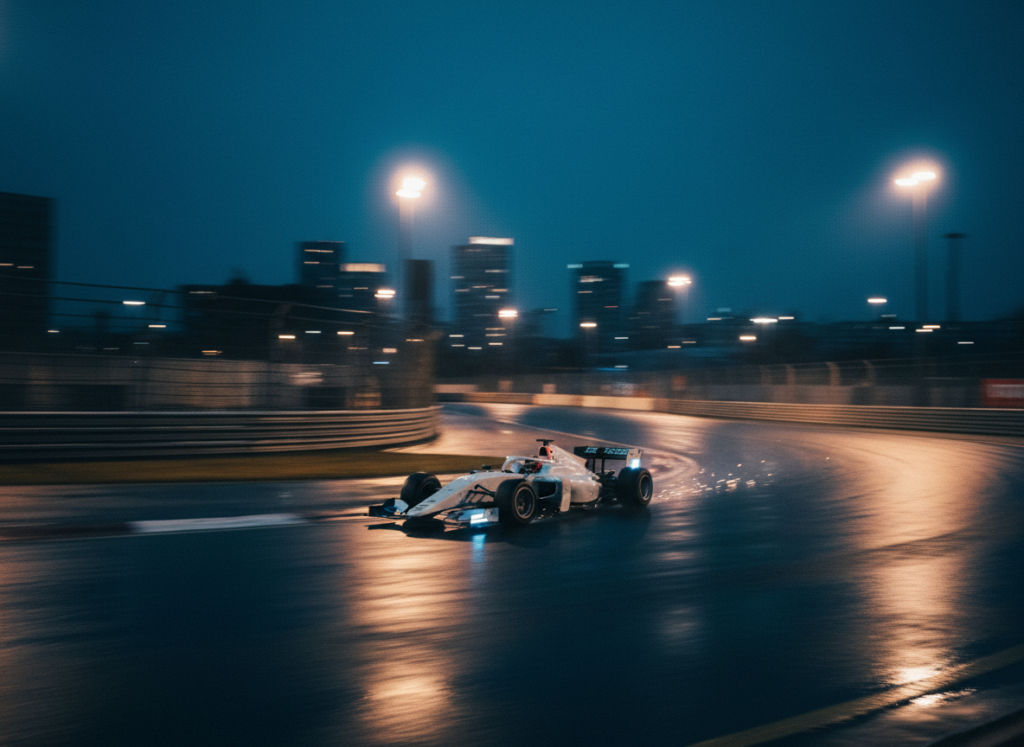
Max Verstappen had never won at Marina Bay. Twelve previous attempts at Singapore had produced plenty of fast laps but not a single victory, making it one of the few obvious gaps left on his résumé. That gap closed on October 11, 2026, when the Red Bull driver led every lap of the Singapore Grand Prix to beat Ferrari’s Charles Leclerc by 7.335 seconds, on a weekend that had already produced a first-lap crash for title contender George Russell and a collision between both McLarens in the sprint race.
A lights-to-flag win, finally
Verstappen converted pole position into control from the first corner, holding off an early lunge from Leclerc into Turn 1 and never relinquishing the lead across 62 laps of the floodlit street circuit. His margin at the flag undersells how comfortable the win looked once he settled into a rhythm. Kimi Antonelli completed the podium 24.573 seconds back after working past Lando Norris and then snatching third from Lewis Hamilton into Turn 16 with laps to spare. It was Verstappen’s 73rd career win, from his 250th grand prix start, and his first at a circuit that had resisted him for over a decade.
Norris and Oscar Piastri rounded out the top five for McLaren, both well out of touch with the podium fight, while Hamilton salvaged sixth for Ferrari despite a tyre call he admitted afterwards he regretted. Liam Lawson, Nico Hulkenberg, Russell and Isack Hadjar followed in the points, with Pierre Gasly eleventh. Lance Stroll, Franco Colapinto and Gabriel Bortoleto all retired, the latter’s car catching fire after a gearbox failure.
The sprint that nearly wrote a different story
Saturday’s sprint hinted at a completely different weekend narrative. Russell took the lead from pole at the start, only to lose the rear of his Mercedes exiting the final corner on the opening lap and slide into the wall, a crash that cost him the win and, more importantly, points to title rival Antonelli. “I’m fine. Sorry, sorry, sorry,” he said afterwards. Verstappen inherited the lead and held on to beat Hamilton, with Leclerc completing that podium.
McLaren had its own crisis later in the sprint when Norris attacked Piastri into Turn 5 on a drying track. The pair made contact and both spun, with Piastri eventually sliding into the wall and being classified 14th, a lap down. No penalty followed a stewards’ review, but the damage to Piastri’s weekend was already done before Sunday’s main event had even started. Add a rain delay that pushed the sprint start back by roughly half an hour and a first-lap clash between Sergio Perez and Stroll, and Marina Bay delivered one of its more chaotic Saturdays in recent memory, a reminder of how much can change between a chaotic qualifying session and a clean race, something we broke down in our guide to how F1 qualifying works.
Strategy: one stop, two stops, and a Hamilton gamble
Sunday’s race turned on tyre strategy as much as raw pace. Most of the grid split between soft and medium compounds for what was expected to be a one-stop race. Verstappen started on softs, switched to mediums on lap 33, and simply controlled the gap from there. Leclerc and Antonelli each ran a two-stop strategy, using a pair of Virtual Safety Car periods, one for Bortoleto’s smoking car, the other for Stroll’s stricken Aston Martin at Turn 15, to take their second stops without losing significant time. Piastri’s race was further compromised by a slow puncture that forced an unplanned second stop on lap 42.
Hamilton’s race unraveled through strategy rather than pace. He pitted once, on lap 19, for a fresh set of softs, and chose not to stop again, a call he apologised for afterwards as Antonelli’s two-stop Mercedes caught and passed him for third in the closing laps. It is the kind of decision that separates a podium from a lonely sixth, and a reminder of why race engineers spend an entire grand prix weekend running the numbers before a single lights-out, a process we have gone deep on in our breakdown of F1 race strategy and tyre mathematics.
Where the championship stands now
Antonelli’s third place at Marina Bay extended the championship lead he built with his breakthrough victory at the brand-new Madring circuit in Madrid last month, and Russell’s sprint crash only widened that gap, with his own team confirming he now sits 89 points behind his teammate with six rounds still to run. Verstappen’s win keeps Red Bull firmly in the title conversation too, continuing a run of races in which no two weekends have looked alike, Russell beat him by fractions of a second at the Azerbaijan Grand Prix just two weeks earlier, and now Verstappen has answered back at a circuit that had never suited him.
Leclerc’s second place is Ferrari’s best result in weeks, timely given how messy Hamilton’s Sunday turned out to be by comparison, while Piastri’s double disappointment, a sprint crash followed by a race-day puncture, leaves him with real ground to make up before the season winds down.
Next up: Austin
The paddock gets a rare weekend off before the United States Grand Prix at the Circuit of the Americas on October 23-25, the next chance for Russell, Piastri and anyone else with a point to prove at Marina Bay to put the record straight.