
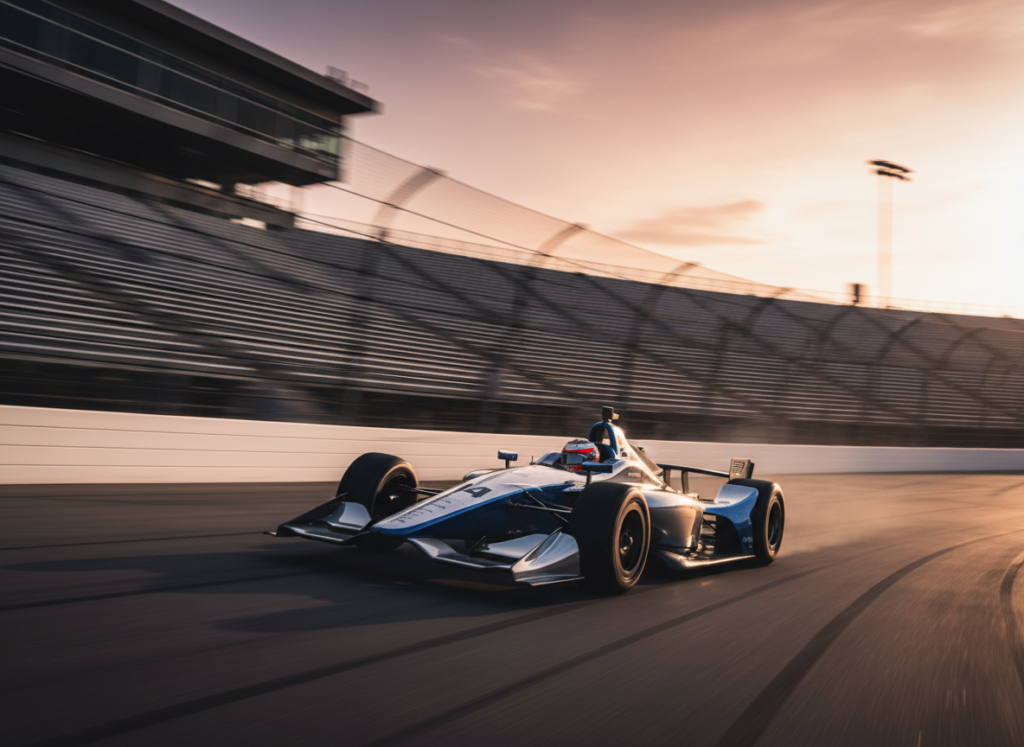
No other championship on the planet asks its drivers to do what IndyCar does. Inside a five-month season, the same field of cars and the same points table cover 230 mph banked ovals, tight temporary street courses, and permanent road circuits with heavy braking zones — sometimes on back-to-back weekends. Formula 1 never sees an oval. NASCAR barely leaves them. IndyCar lives in all three worlds at once, and that variety is the reason the series produces some of the closest, least predictable racing anywhere.
If you’ve only half-followed IndyCar — maybe you know the Indianapolis 500 and not much else — here’s what’s actually happening under the surface: one shared chassis, two rival engine manufacturers, a strategic push-to-pass button, and a scoring system built to reward consistency over a long season rather than any single result.
One Series, Three Completely Different Kinds of Racing
IndyCar’s calendar is built around what teams call the triple crown of American open-wheel racing: superspeedway ovals, purpose-built road courses, and street circuits laid out on closed public roads. Each demands a completely different setup. An oval car runs stiff, asymmetric suspension tuned for sustained high-speed banking and drafting, where being a few pounds of downforce off can be the difference between leading and crashing. A street circuit car needs mechanical grip, strong low-speed braking, and a driver who can thread 90-degree corners between concrete walls with almost no room for error.
That variety is exactly what separates IndyCar from its closest rival for American motorsport attention. Our technical comparison of F1 and IndyCar breaks down how differently the two series approach chassis rules and aerodynamics, but the short version is this: F1 never turns a wheel on an oval, and IndyCar’s spec-chassis rules exist precisely because oval racing at 230 mph leaves almost no margin for aerodynamic experimentation.
The Indianapolis 500 sits at the center of that oval tradition — the oldest and most prestigious race in American motorsport, run every Memorial Day weekend at the 2.5-mile Indianapolis Motor Speedway. It carries the same championship points as any other round on paper, but its prize money, history and cultural weight make it the race every driver on the grid is measured against.
The Cars: One Chassis, Two Engine Suppliers
Every full-time IndyCar entry runs the same Dallara-built spec chassis, a rule the series has enforced for years specifically to keep costs down and competition close — no team can simply out-engineer the field with a faster tub. What separates the cars mechanically comes down to power: Chevrolet and Honda are the sport’s only two engine suppliers, each building a 2.2-liter twin-turbocharged V6 under a tightly controlled formula. In February 2026, both manufacturers confirmed a multi-year renewal of their commitment to the series, locking in the two-supplier structure for years to come.
Since mid-2024, that V6 has been paired with a hybrid energy-recovery unit mounted in the bellhousing between the engine and gearbox — notable because it stores energy in supercapacitors rather than a conventional lithium-ion battery, a choice made for rapid charge-and-discharge cycling rather than long-range storage. It gives drivers a usable power boost during racing and, just as importantly, lets them restart a stalled engine on track without help — something that used to end a driver’s day on the spot.
Push-to-Pass: The Strategic Wildcard
On road and street courses, drivers also get push-to-pass: a limited allotment of extra turbo boost, deployed at the press of a steering-wheel button, that adds a genuine burst of straight-line speed for overtaking or defending. It’s rationed in seconds per race, so using it too early can leave a driver defenseless in the closing laps. It’s also become a genuine flashpoint — IndyCar tightened enforcement against illegal push-to-pass use during the 2026 season and expanded where drivers are permitted to use it, including on race restarts, after several high-profile controversies over teams stretching the rules.
How a Season Is Actually Won
IndyCar’s championship runs on a sliding points scale: the race winner earns the most points, with the total decreasing step by step down through the finishing order, plus small bonus points available for leading a lap and for leading the most laps in a race. Because every round — from the Indy 500 to a one-off street race — feeds into the same table, the title tends to reward the driver who avoids disasters and finishes strongly week after week, rather than the driver with the single most spectacular win. That’s part of why IndyCar champions are so often described as complete drivers: the series is deliberately built so that mastering only ovals, or only street courses, isn’t enough to win a title.
Why It’s Worth Watching
The combination of a spec chassis, two closely matched engine manufacturers, and three wildly different track types produces something increasingly rare in top-level motorsport: genuine competitive uncertainty. Grid order shuffles between oval, road and street rounds in a way it simply doesn’t in series built around a single discipline, and push-to-pass adds a layer of in-race strategy that rewards nerve as much as raw pace.
If you’re building out a wider watchlist beyond IndyCar, our guide to the best motorsport series in the world ranks where it sits against F1, WEC and others, and our breakdown of how NASCAR actually works is the clearest way to see just how differently America’s other major oval series approaches the same basic idea of stock-bodied, high-speed racing.