
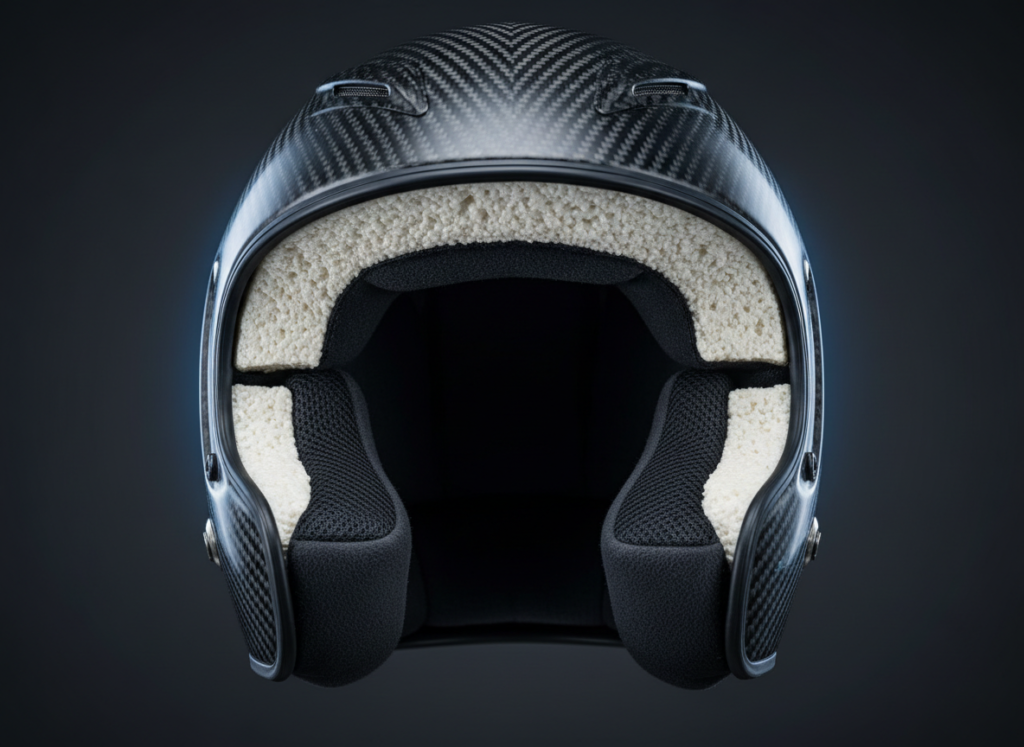
A motorsport helmet is not really headwear. It is a piece of structural engineering, built from overlapping layers that are each tuned to fail in a specific, controlled way the instant a driver’s head takes an impact it was never supposed to survive. Behind the paint job and the sponsor decals sits a stack of composite materials, foam, and strapping refined over decades of crash data, laboratory testing, and, more bluntly, fatal accidents that forced the sport to rewrite its own rulebook.
Every category from Formula 1 to club-level karting certifies its helmets against an international standard, and those standards keep getting harder to pass. Here is what is actually inside one, and why the design looks so different from the open-face lids that were still common on a Grand Prix grid a few decades ago.
The Shell Has to Be Strong, Then It Has to Give
The outer shell of a top-tier racing helmet is typically a composite blend of carbon fibre, aramid fibre (commonly known by the brand name Kevlar), and sometimes fibreglass, laid up in specific orientations to control how the structure behaves under load. The goal is not maximum hardness. A shell that is too rigid transmits more force directly into the skull on impact, so manufacturers tune the layup to spread load across the structure and absorb energy rather than bounce it straight back into the driver’s head. The same logic drives composite choices in other parts of a race car, from body panels down to the carbon monocoque chassis that protects the driver’s survival cell.
Underneath the Shell, a Foam Liner Does the Real Work
Strip away the shell and the next layer is an energy-absorbing liner, usually a dense expanded polystyrene (EPS) foam similar in principle to what is used in cycling or motorcycle helmets, but engineered for far higher impact speeds. Its job is to crush progressively on impact, extending the time over which the head decelerates and reducing the peak force that reaches the brain. Helmet weight is tightly regulated for the same reason it matters in the cockpit generally: drivers sustain repeated lateral and vertical g-forces through a race, and a heavier helmet strains the neck under load without necessarily improving protection. Getting that balance right, enough liner to absorb energy without pushing the helmet over its weight limit, is one of the hardest parts of the design.
Not Every Helmet Is Certified the Same Way
The toughest widely used benchmark is the FIA 8860 standard, required in Formula 1, Formula 2, Formula 3 and other top single-seater and endurance categories. It layers on tests that older standards don’t require: an oblique impact test measuring rotational force on the head, a more severe crush test, a flame test simulating direct exposure to a fuel fire, and a chin-strap pull test to confirm the retention system holds under extreme load. Most national championships and GT racing, including categories covered under GT3’s homologation rules, run on the slightly less stringent FIA 8859 standard instead, while rally helmets add their own requirements, like integrated intercom mounts, to suit the format covered in how the World Rally Championship actually operates stage to stage. None of these standards are static; the FIA revises them roughly every five to ten years as crash data and materials improve.
The Visor Has Its Own Crash Test
Visors go through a ballistic test of their own: a projectile is fired at the lens at racing-relevant speed, and it has to hold without penetrating. The visor itself is usually polycarbonate, and since the mid-2000s, following a string of incidents where debris struck drivers in the visor area at high speed, helmet makers have added reinforcement strips across the top edge to reduce the risk of an object slipping underneath. Tear-off layers, stacked thin plastic films drivers rip away mid-race to clear debris or rain, sit on top without compromising that ballistic rating.
Why the HANS Device Reshaped Helmet Design
For most of motorsport’s history, a helmet protected the skull but did nothing for the neck, and sudden deceleration could cause a basilar skull fracture even when the shell itself survived intact. A string of fatal accidents in American open-wheel racing in the late 1990s, followed by Dale Earnhardt’s fatal crash at the 2001 Daytona 500 while wearing an open-face helmet with no head-and-neck restraint, pushed NASCAR toward mandating head-and-neck support systems; top open-wheel categories had already begun moving the same direction. Modern helmets are built with dedicated anchor points so a HANS-type device clips directly onto the shell, turning the helmet, the restraint and the seat into one linked safety system instead of three separate pieces of equipment.
The Next Frontier Is Rotational Impact
Newer research, echoing work done in American football and cycling helmet design, has shifted attention toward rotational and angular acceleration as a driver of concussion and brain injury, not just direct linear impact. That’s part of why the FIA built an oblique, rotation-measuring test into the 8860 standard, using more biofidelic test headforms fitted with sensors that weren’t available when earlier standards were written. Expect future helmet generations to lean further into liners with built-in slip planes, designed to let the shell rotate slightly relative to the head during an off-angle hit, rather than transferring that twisting force straight through.
None of this happened by design foresight alone. Almost every layer in a modern racing helmet, the composite weave, the liner density, the visor reinforcement, the HANS anchor points, traces back to a specific failure the sport studied and then engineered its way around. It’s a reminder that the equipment drivers strap on before every session is less a piece of safety gear than a running record of what motorsport has already learned the hard way.