
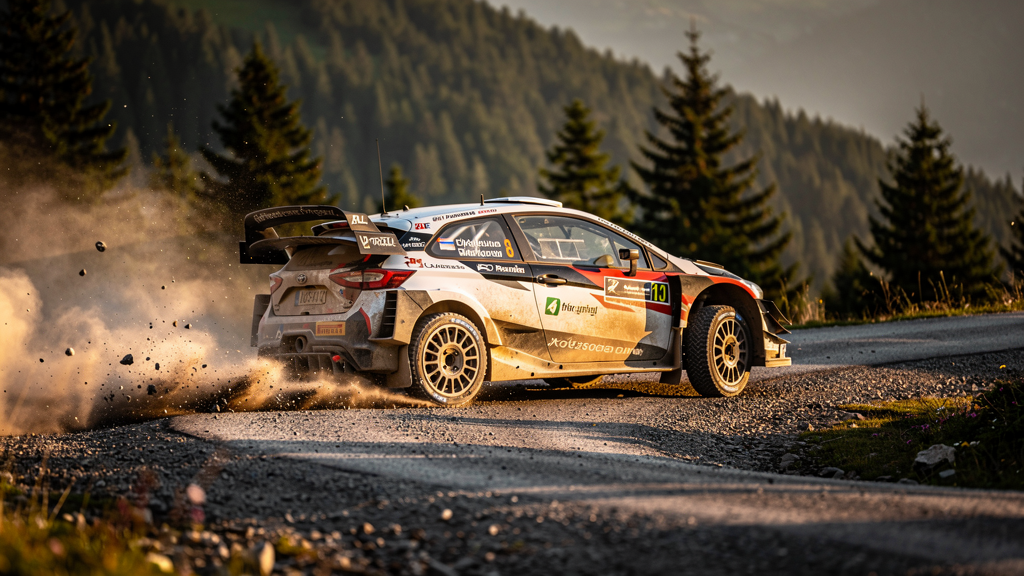
Toyota already had nine World Rally Championship manufacturers’ titles sitting in the cabinet before the service park in Chile even opened. By Sunday evening, it had a tenth — equalling Lancia’s all-time record — and the credit belonged to a driver who, for most of 2026, hadn’t looked like a title threat at all. Oliver Solberg led from the first stage to the last, beat his own teammate Sébastien Ogier by 16.6 seconds, and turned a championship that looked settled into one that will go down to the final two rounds.
It’s a rare kind of weekend: a manufacturers’ crown wrapped up and a drivers’ fight blown wide open on the same gravel roads, inside the same three days.
Solberg’s Commanding Weekend in Bío Bío
Rally Chile Bío Bío, round 12 of 14 on the 2026 calendar, was supposed to be about the championship leaders managing risk. Instead, Oliver Solberg and co-driver Elliott Edmondson set the pace almost from the drop of the flag, winning every stage but one across the weekend and never really being under threat at the front. It’s the kind of dominant run that’s easy to undersell on a results sheet, because the number that actually tells the story is the margin: 16.6 seconds, over an entire rally, against a Toyota GR Yaris Rally1 driven by a nine-time world champion.
That teammate was Sébastien Ogier, who took second and, in doing so, logged his 120th career WRC podium — drawing him level with Sébastien Loeb’s long-standing record. Adrien Fourmaux brought his Hyundai home third, roughly 33 seconds off the win. For readers newer to the discipline, our World Rally Championship explainer breaks down how the Rally1 hybrid cars, stage format and scoring actually work — useful background for why a gap measured in single-digit seconds per stage can add up to a 16-second rally win.
For Solberg personally, it was his second win of the 2026 season after Monte Carlo in January, and the third of his WRC career. Coming from a driver whose title hopes had looked all but gone a few rounds earlier, the timing could not have been better.
Toyota Ties Lancia’s All-Time Manufacturers’ Record
Solberg’s win did double duty: it also sealed the 2026 manufacturers’ championship for Toyota Gazoo Racing WRT, the team’s tenth title in WRC history. That total now matches Lancia, whose run of championships in the 1970s and 80s had stood as the benchmark for four decades. With a sister car on the podium and Elfyn Evans — the third member of Toyota’s driver line-up — still leading the drivers’ standings at the time, the manufacturers’ math was effectively beyond reach for any rival team before the weekend was even finished.
It’s the second global manufacturers’ title Toyota has wrapped up inside a matter of weeks, after its WEC Hypercar squad also moved to the top of that championship following a late-race gamble at the 6 Hours of Fuji. Different continents, different categories, different cars entirely — but the same manufacturer applying the same depth of resources to both programmes at once.
Evans’ Puncture Turns a Cruise Into a Scramble
The drivers’ championship picture would look very different if not for a single tyre. Elfyn Evans went into the final day of competition running comfortably inside the podium positions and in complete control of his title lead, only for a puncture on the penultimate stage to cost him roughly two minutes — enough to drop him from second all the way down to fifth by the time he crossed the finish ramp. Evans still leaves Chile as championship leader, which says plenty about the cushion he’d built over the first eleven rounds, but that cushion is now a great deal thinner than it was on Saturday morning.
Sami Pajari — the third Toyota driver in the title mix — sits 17 points behind Evans after a fourth-place finish, and Solberg’s victory pulls him to within 21 points of the lead. That’s three drivers from the same team, separated by three weeks’ worth of points, heading into the final two rounds of the year. Toyota has already won the manufacturers’ title; which of its own drivers ends up lifting the individual crown is now the only question left on the table.
Two Rounds Left: What’s Actually at Stake
The calendar now moves to Rally Italia Sardegna, round 13 of 14, before the season closes out at its final event. Gravel has decided plenty in Chile; Sardinia’s rougher, rockier surface tends to punish mistakes just as harshly, which makes the next round less about outright pace and more about which of Evans, Pajari or Solberg can keep their car in one piece under pressure. A 21-point gap with two rallies to go is not insurmountable in a sport where a single puncture can cost two minutes, as Evans found out this weekend.
There’s also a wider pattern worth noting. Toyota’s Rally1 hybrid system — like the hybrid units now running in Formula 1’s 2026 power units — adds a layer of energy deployment strategy on top of pure driving speed, and getting that wrong under pressure can be just as costly as a mechanical failure. Evans’ misfortune in Chile was a tyre, not a hybrid system fault, but the broader point stands: modern WRC title fights are won and lost on small margins that have nothing to do with who’s fastest on a stage map.
Toyota has its manufacturers’ title. What it doesn’t have yet is clarity on which of its three drivers will be the one celebrating in the finale — and after Chile, that’s arguably the more interesting story left in the 2026 World Rally Championship.