
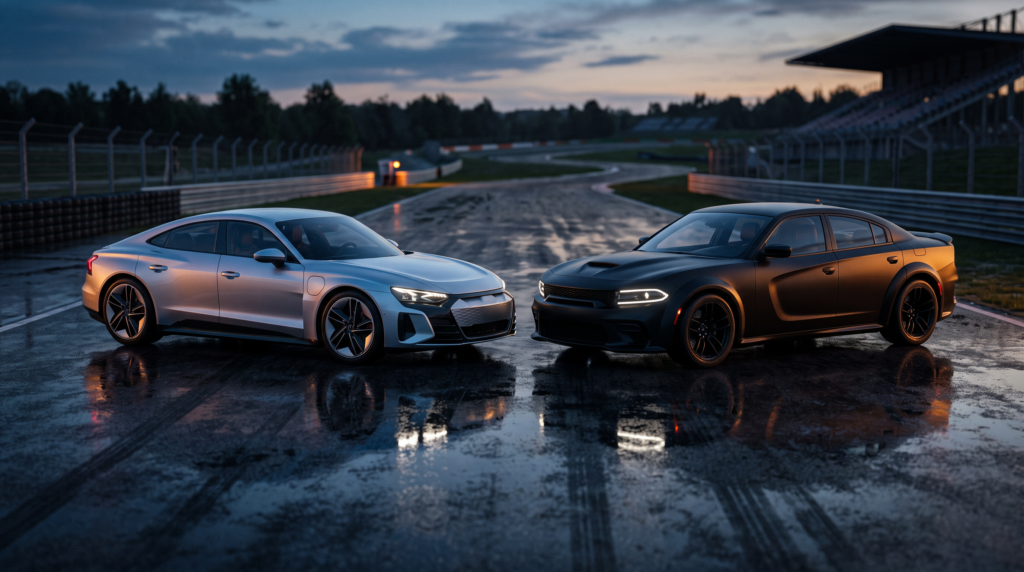
Electric performance flagships used to mean one thing: Tesla. That changed the moment Porsche hung the Turbo GT badge on the Taycan, a car built specifically to embarrass the Model S Plaid at its own game — in a straight line, on a track, and anywhere speed limits don’t apply. Both cars have, at various points, held the title of quickest-accelerating production vehicle sold in the US, and both claims are defensible depending on how the number is measured. Here’s what the published figures — and the engineering behind them — actually say once you put them side by side.
Power and Acceleration: Two Different Routes to Brutal
Tesla’s approach is the blunter of the two. The Model S Plaid uses three electric motors — one up front, two at the rear — for a combined output of roughly 1,020 hp, and Tesla quotes a 0-60 mph time of around 2 seconds. There’s no multi-speed gearbox involved; all three motors drive through fixed-ratio reduction gears, and the car relies on sheer electrical overhead and tyre grip to put that power down.
Porsche’s Taycan Turbo GT, in its Weissach-package form, makes do with “only” 777 hp from its dual motors, yet still covers 0-60 mph in about 2.2 seconds — a tenth or two behind the Plaid on paper, but close enough that real-world conditions (tyre temperature, road surface, launch control calibration) can easily close the gap. Porsche’s trick is a two-speed transmission on the rear axle, a feature almost no other EV bothers with, because the complexity rarely pays for itself outside of a car this track-focused. It lets the Taycan hold peak acceleration across a wider speed band instead of tailing off once the Model S Plaid’s gearing runs out of headroom. For more on how the quickest cars on sale actually rank once you look past the marketing claims, our rundown of the fastest production cars in 2026 puts both of these into context against gas-powered hypercars.
Range and Efficiency: Where the Advantage Flips
Here the result reverses completely. The Model S Plaid carries a 100 kWh battery and is EPA-rated at around 368 miles of range — a genuinely long-legged number for a car this fast. The Taycan Turbo GT, despite a physically larger 105 kWh pack, is EPA-rated at roughly 276 miles. That near-100-mile gap comes down to weight and aerodynamic priorities rather than battery chemistry: the Taycan’s extra gearbox hardware, its torque-vectoring rear differential and a chassis tuned first for lap times add mass that the Plaid’s simpler drivetrain doesn’t carry, and Tesla’s development obsession with drag coefficient and motor efficiency (helped by its in-house silicon carbide inverters) continues to show up directly in EPA testing.
Charging habits matter here too. A Model S Plaid owner doing mixed commuting and road trips will likely visit a fast charger noticeably less often than a Turbo GT owner covering the same mileage, which is worth weighing against the Porsche’s higher peak charging rate on a well-chosen DC fast charger — a factor that narrows, but doesn’t erase, the real-world range deficit.
Price and Value: A Six-Figure Gap That Changes the Conversation
This is where the comparison stops being close. The Model S Plaid starts at roughly $111,630. The Taycan Turbo GT with the Weissach performance package starts at around $233,350 — more than double. Even buyers who want a Porsche-badged EV without going all the way to Turbo GT money have options: the standard Taycan lineup starts closer to $102,550, and the Taycan 4S and GTS trims fill in a wide middle ground with less extreme power but the same two-speed chassis character, for considerably less than six figures north of the Plaid.
Framed as pure speed-per-dollar, the Model S Plaid isn’t just competitive with the Turbo GT — it’s arguably the best bargain in the entire quickest-cars conversation, electric or otherwise. The Taycan’s price tag is really buying something else: a specific kind of chassis feel, a badge, and a level of track-day durability (brake cooling, thermal management for repeated hot laps) that the comparison sheet doesn’t capture in a 0-60 number.
How They Actually Drive
Numbers aside, these two cars feel like they come from different philosophies entirely. The Model S Plaid is software-first: its character is shaped by drive-mode selection, over-the-air updates, and a yoke-optional interior that prioritizes screens over switchgear. It’s extraordinarily quick in a way that can feel slightly abstract — the acceleration is almost too smooth and too silent to fully register at first.
The Taycan leans on decades of chassis-tuning heritage that Porsche also applies to its combustion cars — the same engineering group responsible for sorting out cars like the 911 GT3 and GT3 RS had a hand in how the Turbo GT manages weight transfer and steering feel. The two-speed rear gearbox isn’t just a straight-line trick; it changes how the car rotates mid-corner compared with a single-speed EV, giving it a more adjustable, deliberately “driven” feel rather than a purely point-and-shoot one. Whether that’s worth the price premium depends entirely on how much of your ownership experience actually happens on a track versus a commute.
Verdict: Which One Should You Actually Buy
If the goal is maximum speed and range per dollar, with a daily-driver cabin layout and Tesla’s charging network behind it, the Model S Plaid is the easy, rational pick — it undercuts the Taycan Turbo GT by more than $120,000 while matching or beating it in a straight line. If the goal is a chassis that feels engineered for corners rather than just quarter-miles, with badge cachet and the kind of resale stability Porsche EVs have started to show, the Turbo GT earns its premium for a specific buyer. Enthusiasts cross-shopping combustion alternatives in this price bracket should also look at how a car like the BMW M3 stacks up against Audi’s hybrid RS5 — a reminder that six figures still buys a lot of choice outside the EV flagship fight entirely.
Either way, both cars are proof that the “fastest car” conversation isn’t settled by a single number anymore. It depends on which number you’re asking about — and increasingly, on which philosophy of speed you’d rather live with every day.