
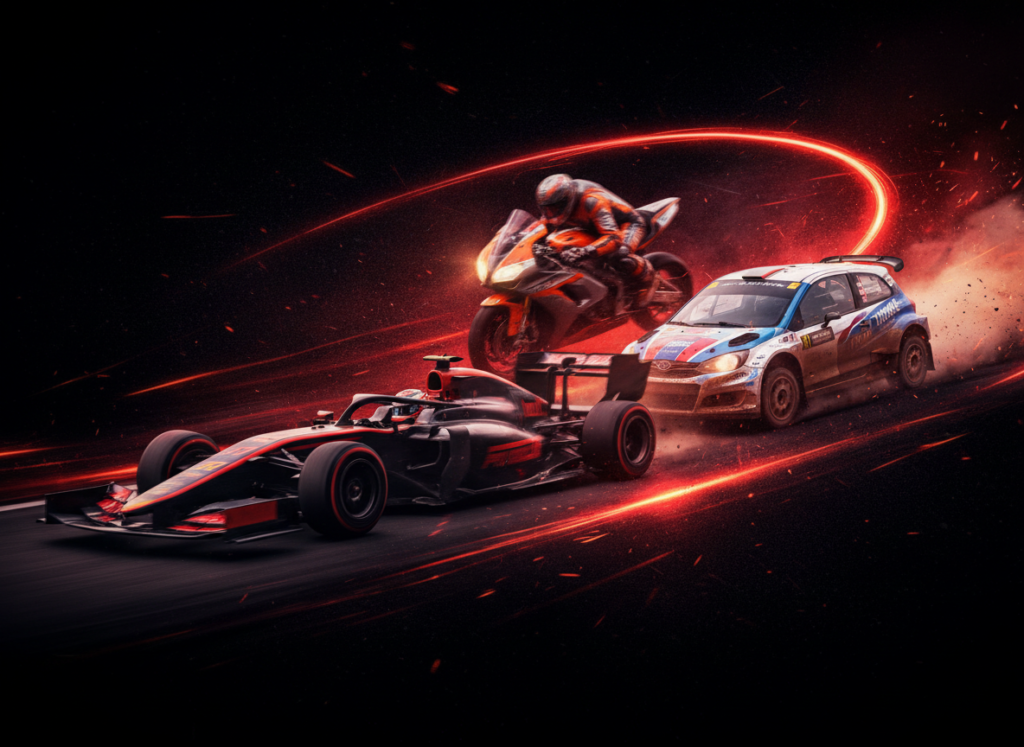
The best motorsport series in the world share one thing in common — they make you forget everything else the moment the lights go out.
But with dozens of championships running across every continent, knowing where to start is genuinely overwhelming. Formula 1 gets all the headlines. But some of the greatest racing on the planet happens far from the Monaco paddock and the Silverstone grandstands.
We ranked the ten best motorsport series in the world in 2026 — and explained exactly what makes each one worth your Saturday afternoon.
1. Formula 1 — The Pinnacle
Season: March–December | Rounds: 24 | Global TV Audience: 1.5 billion**
Formula 1 is the undisputed king of motorsport.
The fastest cars, the biggest budgets, the most talented drivers, and the most sophisticated engineering on the planet. A single F1 race weekend involves more technology than the Apollo moon program. The racing happens at circuits from Bahrain to Las Vegas, from Silverstone to Singapore.
What makes F1 unmissable in 2026:
- Max Verstappen’s pursuit of a fifth championship
- The ongoing development war between Red Bull, Mercedes, and Ferrari
- 24 race weekends providing storylines that evolve across an entire year
- Technical regulations that push engineering to its absolute limit
The criticism — that F1 can be processional — is legitimate. But when it’s good, nothing in motorsport touches it.
2. MotoGP — Two-Wheel Perfection
Season: March–November | Rounds: 20 | Global TV Audience: 400 million**
MotoGP is Formula 1 on two wheels — and in many ways, it produces better racing.
The championship is genuinely competitive. Multiple manufacturers — Ducati, Honda, Yamaha, Aprilia, KTM — produce machines capable of winning races. The gap between the best and worst teams is smaller than in F1. And the racing is consistently closer, more unpredictable, and more physically spectacular than almost anything on four wheels.
The 2023 and 2024 seasons were among the greatest in the sport’s history — double-figure different race winners, championship battles going to the final round, and riding standards that continue to push the limits of what humans can do on a motorcycle.
If you only watch one motorsport series alongside F1, make it MotoGP.
3. World Rally Championship — The Ultimate Driving Challenge
Season: January–November | Rounds: 14 | Global TV Audience: 150 million**
The WRC takes place not on purpose-built circuits but on public roads — gravel tracks in Finland, tarmac mountain passes in Monaco, snow-covered stages in Sweden, and desert tracks in Kenya.
Drivers navigate at speeds exceeding 200 km/h with one hand on the wheel and one ear on their co-driver, who reads pace notes describing every corner, crest, and hazard in the road ahead. The precision required is extraordinary. The bravery required is almost incomprehensible.
Modern WRC cars are hybrid-powered, four-wheel-drive machines producing around 500 hp. They jump, slide, and drift through stages that would stop a road car dead — and they do it faster than seems physically possible.
The WRC is motorsport in its most elemental form.
4. Formula E — The Electric Future
Season: January–July | Rounds: 16 | Global TV Audience: 200 million**
Formula E divides opinion more than any other series on this list — and that’s exactly what makes it interesting.
Street circuits in city centers. Genuinely close racing. A one-make tire that levels the playing field between manufacturers. And the political and environmental context of electric racing happening in the middle of urban environments.
The criticism that Formula E is too slow — cars reach approximately 280 km/h versus F1’s 372 km/h — misses the point. The racing is closer, the circuits tighter, and the wheel-to-wheel action more frequent than in F1.
Formula E’s manufacturer roster — Porsche, Jaguar, Nissan, DS, Maserati — reflects a serious commitment from the automotive industry. This is not a marketing exercise. This is where electric racing technology is developed.
5. NASCAR Cup Series — American Thunder
Season: February–November | Rounds: 36 | US TV Audience: 4-5 million per race**
European fans often dismiss NASCAR. They’re wrong.
The NASCAR Cup Series is the highest attended motorsport championship in the world. Its 36-round season produces racing that is simultaneously simpler and more chaotic than F1 — pack racing at superspeedways, short track battles at Bristol, and road course events that expose the skill gap between drivers.
The Next Gen car, introduced in 2022, has produced closer racing and more competitive fields than the previous generation. And the storylines — manufacturer loyalty, team politics, contract dramas — make F1’s paddock intrigue look restrained.
If you’ve never watched a NASCAR short track race at Martinsville or Bristol, you’re missing some of the most intense wheel-to-wheel racing on the planet.
6. IndyCar Series — America’s Open Wheel
Season: March–September | Rounds: 17 | US TV Audience: 1-2 million per race**
IndyCar is Formula 1’s American cousin — and in terms of driver talent and on-track action, it often surpasses its European counterpart.
The series runs on a mix of oval tracks and road courses, producing racing that is simultaneously more dangerous and more spectacular than anything in F1. Speeds on oval tracks exceed 380 km/h. The draft — the aerodynamic slipstream effect — creates passing opportunities that F1 can only dream of.
The Indianapolis 500 — held on Memorial Day weekend at the iconic Brickyard — remains one of the three greatest single-day sporting events in the world. 300,000 spectators. 500 miles. 33 cars racing at 370 km/h.
7. 24 Hours of Le Mans / FIA WEC — Endurance at its Greatest
Season: April–November | Rounds: 7 | Le Mans attendance: 250,000**
The 24 Hours of Le Mans is the greatest single motorsport event in the world.
Nothing else comes close to the combination of speed, strategy, endurance, and human drama that unfolds over a full day and night at the Circuit de la Sarthe. Hypercar-class machines — from Ferrari, Toyota, Porsche, and Cadillac — lap the 13.6 km circuit at average speeds exceeding 240 km/h for 24 consecutive hours.
The FIA World Endurance Championship that surrounds Le Mans has experienced a renaissance since the introduction of the Hypercar regulations in 2021, attracting manufacturer investment not seen since the 1980s.
Watching the sun rise over the Porsche Curves at 6am, with the leaders still 12 hours from the finish, is an experience that no other motorsport provides.
8. British Touring Car Championship — The Tin-Top Classic
Season: April–October | Rounds: 10 (30 races) | Attendance: 30,000+ per event**
The BTCC is the greatest domestic touring car championship in the world — and one of the most entertaining motorsport series of any kind.
Family saloons and hatchbacks — Honda Civic, BMW 1 Series, Hyundai Elantra — modified to produce 360 hp and race on slick tires. The result is close, aggressive, contact-heavy racing that produces carnage at almost every round.
The reverse grid format — where the top points scorers start from the back in race three of each round — creates chaos that is entirely deliberate and enormously entertaining. The BTCC is proof that the most expensive cars don’t always produce the best racing.
9. Extreme E — Off-Road Electric
Season: March–October | Rounds: 5**
Extreme E takes electric SUVs to the most remote and environmentally significant locations on Earth — the Amazon rainforest, the Arctic, the Sahara Desert, the Himalayas — and races them in a format designed to highlight climate change.
The racing itself is surprisingly entertaining — high-powered electric SUVs battling over rough terrain in head-to-head elimination formats. But Extreme E’s real significance is its legacy program — each event includes an environmental project that continues after the racing leaves.
It’s motorsport with a purpose beyond speed.
10. Formula 2 — The F1 Nursery
Season: March–November | Rounds: 14 | Broadcast: Sky Sports F1, F1 TV**
Formula 2 is where the next generation of Formula 1 drivers are made.
Every current F1 driver passed through F2 or its predecessor GP2. Watching F2 in 2026 means watching the names that will dominate F1 headlines for the next decade — before they get there.
The spec-car format — all teams run identical Dallara chassis and Mecachrome engines — eliminates the equipment advantage and produces racing decided entirely by driver skill. And the F2 calendar runs alongside F1, meaning every F2 race weekend is broadcast to the same global audience as the main event.
If you want to find the next Hamilton or Verstappen before everyone else does — watch F2.
The Rankings at a Glance
| Rank | Series | Best For |
|---|---|---|
| 1 | Formula 1 | Pinnacle engineering and global drama |
| 2 | MotoGP | Best pure racing action |
| 3 | WRC | Most spectacular driving environment |
| 4 | Formula E | Electric future of motorsport |
| 5 | NASCAR | Pack racing and American spectacle |
| 6 | IndyCar | Oval speed and Indianapolis 500 |
| 7 | WEC / Le Mans | Greatest single motorsport event |
| 8 | BTCC | Best value, closest racing |
| 9 | Extreme E | Motorsport with environmental purpose |
| 10 | Formula 2 | Future F1 stars before they make it |
Conclusion: There Has Never Been a Better Time to Watch Motorsport
The best motorsport series in the world have never been more accessible.
Streaming services, YouTube highlights, and social media have made it easier than ever to follow multiple championships across different continents. You don’t have to choose between F1 and MotoGP, between WRC and WEC.
Watch everything. Argue about everything. That’s what motorsport fans do.
Follow The Pit Speed for coverage across every major motorsport series — F1, MotoGP, WRC, and everything the world of speed has to offer.
FAQ
Q: What is the most popular motorsport series in the world? Formula 1 has the largest global TV audience of any motorsport series, with approximately 1.5 billion unique viewers across a season. However, NASCAR has the highest single-event attendance figures, and the Indianapolis 500 is considered one of the three most-watched single-day sporting events globally alongside the Super Bowl and the FIFA World Cup final.
Q: Is MotoGP more dangerous than Formula 1? Statistically yes. MotoGP riders have no protective cell around them — a crash at racing speed means direct contact with the track surface. F1 drivers are enclosed in a carbon fiber survival cell with the Halo protection system. Both sports have become dramatically safer in recent decades, but MotoGP carries inherently greater physical risk per race.
Q: Where can I watch Formula 2 races? Formula 2 races are broadcast on Sky Sports F1 in the UK, ESPN in the United States, and F1 TV Pro globally — the official Formula 1 streaming service that provides live coverage of all F1 support series including F2, F3, and Porsche Supercup. F2 races at every Grand Prix weekend, so the schedule follows the F1 calendar.